
“I Can’t Do This.”
How Many Times Have You Said Those Words to Yourself?
Maybe While Learning Something New. Maybe After Making a Mistake. Maybe When Someone Else Seemed Much Better Than You.
“I Can’t Do Business.”
“I Can’t Speak Confidently.”
“I Can’t Learn Technology.”
“I Can’t Write.”
“I Can’t Stay Consistent.”
Sometimes, “I Can’t” Feels Like a Simple Statement of Fact.
But What If It Is Actually a Starting Point Rather Than a Final Answer?
Changing “I Can’t” To “I Can Learn” Doesn’t Mean Pretending Something Is Easy. It Means Recognizing That Your Current Ability Doesn’t Necessarily Define Your Future Ability.
That Small Shift Is at the Heart of Moving from A Fixed Mindset Toward a Growth Mindset.
And When You Start Thinking Differently About What You Can Learn, You May Begin Noticing Possibilities You Previously Ignored.
That Is the Essence of Mega Mindset, Mega Possibilities.
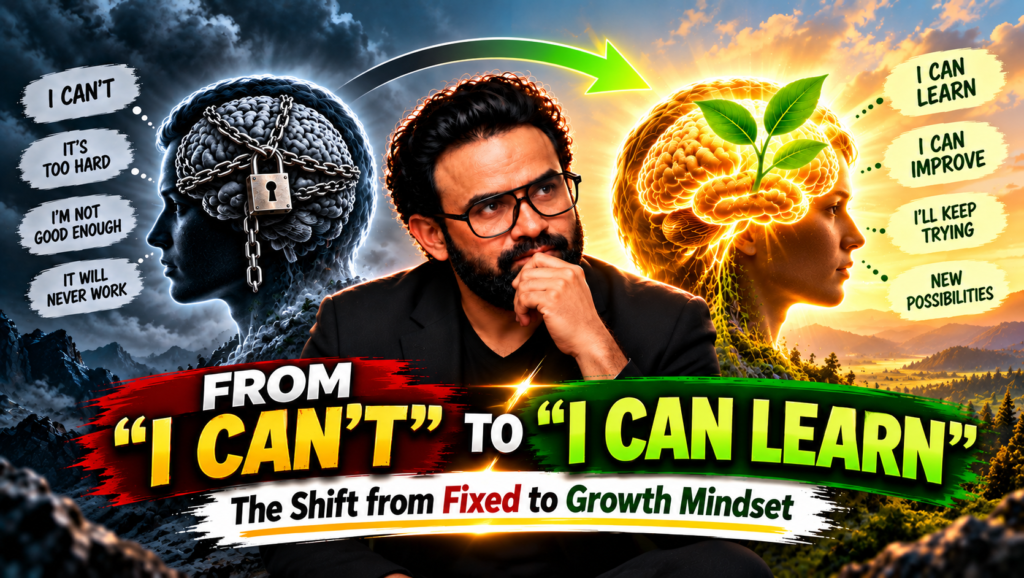
What Does “I Can’t” Really Mean?
When We Say “I Can’t,” We May Actually Mean Many Different Things.
Sometimes It Means:
“I Don’t Know How.”
Sometimes It Means:
Sometimes It Means:
“I Haven’t Practiced Enough.”
“I’m Afraid I’ll Fail.”
Sometimes It Means:
“I’ve Tried Before and It Didn’t Work.”
And Sometimes It Simply Means:
“This Feels Uncomfortable.”
The Problem Begins When We Turn a Temporary Difficulty into A Permanent Identity.
For Example:
“I Don’t Know How to Create a website” Can Be a Fact About Your Current Skill Level.
But:
“I’m Not Capable of Creating Websites” Is A Much Bigger Conclusion.
The First Statement Leaves Room for Learning.
The Second Closes The Door.
The Fixed Mindset Says “This Is Who I Am”
A Fixed Mindset Often Turns Abilities into Identities.
You Might Think:
- “I’m Not a Creative Person.”
- “I’m Bad at Math’s.”
- “I’m Not Confident.”
- “I’m Terrible at Selling.”
- “I’m Not Disciplined.”
- “I Can’t Learn Quickly.”
These Statements Can Become Mental Labels.
Once You Accept the Label, You May Stop Experimenting.
Why Practice Something If You’ve Already Decided You’re Bad at It?
Why Take a Course If You Believe You Can’t Learn?
Why Apply for an Opportunity If You Believe You Aren’t Capable?
This Is How a Belief Can Influence Behavior.
The Belief Doesn’t Necessarily Prove What You’re Capable Of.
But It Can Influence Whether You Give Yourself the Opportunity to Find Out.
The Growth Mindset Says “I Can Learn”
A Growth Mindset Changes the Question.
Instead Of:
“Can I Do This Naturally?”
You Begin Asking:
“What Would I Need to Learn to Do This?”
That’s A Powerful Shift.
Consider Someone Who Wants to Start Creating Videos.
They Might Say:
“I Don’t Know How to Edit Videos.”
That’s Completely Okay.
They Can Learn Editing.
They Can Watch Tutorials.
They Can Practice with Simple Projects.
They Can Make Mistakes.
They Can Improve.
Eventually, Something That Once Seemed Complicated May Become Familiar.
The Ability Wasn’t Necessarily There at The Beginning.
It Developed Through Learning and Practice.
That’s The Growth Mindset in Action.
“Yet” Can Change the Conversation
One Of the Simplest Ways to Challenge Fixed Thinking Is to Add the Word:
Yet.
“I Can’t Do It.”
Becomes:
“I Can’t Do It Yet.”
“I Don’t Understand It.”
Becomes:
“I Don’t Understand It Yet.”
“I’m Not Confident.”
Becomes:
“I’m Not Confident Yet.”
“I Don’t Know How.”
Becomes:
“I Don’t Know How Yet.”
The Word “Yet” Doesn’t Promise Success.
Instead, It Recognizes That Your Current Situation May Be Part of a Learning Process.
It Keeps the Possibility of Improvement Open.
From “I Can’t” to “How Can I?”
There Is Another Powerful Shift You Can Make.
Move From:
“I Can’t.”
To:
“How Can I?”
This Changes Your Mind from Stopping to Exploring.
For Example:
“I Can’t Start a Business.”
Becomes:
“How Can I Learn What I Need to Start One?”
“I Can’t Create Content.”
Becomes:
“How Can I Learn to Create Better Content?”
“I Can’t Manage My Time.”
Becomes:
“How Can I Improve the Way I Use My Time?”
The Question Doesn’t Guarantee an Answer Immediately.
But It Encourages You to Search for One.
And Sometimes the First Step Toward a New Possibility Is Simply Asking a Better Question.
Learning Requires Being a Beginner
One Reason People Hold onto a Fixed Mindset Is That They Don’t Like Feeling Inexperienced.
Being A Beginner Can Feel Uncomfortable.
You Make Mistakes.
You Ask Basic Questions.
Other People May Know More Than You.
Your First Attempts May Look Nothing Like the Results You Imagined.
But That’s Normal.
Nobody Starts as an Expert.
Think About Learning to Ride a Bicycle.
At First, Balance May Feel Difficult.
You May Wobble.
You May Make Mistakes.
But You Don’t Usually Conclude:
“Human Beings Aren’t Meant to Ride Bicycles.”
You Understand That Learning Takes Practice.
The Same Principle Applies to Many Skills.
You Don’t Have to Be Good Immediately.
You Have to Be Willing to Learn.
Don’t Confuse Slow Progress with No Progress
Growth Doesn’t Always Happen Quickly.
You May Practice a Skill for Weeks and Still Feel Like You’re Not Improving Much.
That’s When Fixed Thinking Can Return:
“See? I’m Just Not Good at This.”
Instead, Look for Smaller Signs of Progress.
Maybe You’re Making Fewer Mistakes.
Maybe You Understand Something Faster.
Maybe You’re More Comfortable Than You Were Last Month.
Maybe You Know What Not to Do Anymore.
Progress Isn’t Always Dramatic.
Sometimes Growth Is Simply Becoming Slightly Better Than You Were Before.
Mistakes are Part of The Learning Process
A Mistake Can Mean Different Things Depending on Your Mindset.
A Fixed Mindset May Interpret It As:
“I Failed Because I’m Not Capable.”
A Growth Mindset Can Ask:
“What Caused This Mistake?”
That Question Creates an Opportunity to Learn.
Suppose Your First Social Media Campaign Doesn’t Perform Well.
You Could Say:
“I’m Bad at Marketing.”
Or You Could Examine the Campaign.
Was The Message Unclear?
Was The Audience Wrong?
Was The Offer Difficult to Understand?
Was The Creative Weak?
Did You Test Enough Variations?
The Second Approach Turns an Unsuccessful Attempt into Information.
The Goal Isn’t to Celebrate Failure.
The Goal Is to Learn from Experience.
Five Ways to Practice The “I Can Learn” Mindset
You Can Start Today with Simple Actions.
1. Catch Your “I Can’t” Statements
Notice When You Use Permanent Language.
Write Down the Thought.
Then Ask Whether It Describes a True Limitation or Simply Your Current Skill Level.
2. Add “Yet”
When Appropriate, Add “Yet” To the End of the Statement.
It Creates Room for Possibility.
3. Ask Better Questions
Instead Of Asking:
“Why Can’t I Do This?”
Ask:
“What Do I Need to Learn?”
4. Break Big Skills into Small Steps
You Don’t Have to Master Everything at Once.
Learn One Small Part.
Practise It.
Then Move to the Next.
5. Track Your Progress
Keep A Simple Record of What You are Learning.
Looking Back After A Few Weeks or Months Can Help You Notice Progress That Isn’t Obvious Day to Day.
Your Current Skill Level Is Not Your Final Chapter
Think About Something You Couldn’t Do A Few Years Ago but Can Do Today.
Maybe You Learned to Use a Smartphone.
Maybe You Learned to Drive.
Maybe You Learned a Professional Skill.
Maybe You Learned How to Communicate Better.
Maybe You Learned How to Manage Something That Once Overwhelmed You.
You Changed Because You Learned.
That Doesn’t Mean Every Skill Can Be Mastered by Everyone, Or That Effort Guarantees a Particular Outcome.
It Simply Means That Your Current Abilities are Not the Complete Story of What You May Learn Next.
That’s An Important Distinction.
Build Your Mega Mindset
A Mega Mindset Begins When You Stop Treating Every Limitation as A Permanent Identity.
Instead Of Saying:
“This Is Not Possible for Me.”
Try:
“What Would Make This Possible?”
Instead Of:
“I’m Not Good Enough.”
Try:
“What Can I Improve?”
Instead Of:
“I Don’t Know How.”
Try:
“Where Can I Learn?”
Instead Of:
“I Failed.”
Try:
“What Can This Experience Teach Me?”
These Questions Won’t Magically Solve Every Problem.
But They Can Change What You Look For.
And What You Look for Can Influence What You Notice, What You Learn and What Actions You Take.
That Is Where Possibilities Begin to Expand.
Final Thoughts
The Journey From “I Can’t” To “I Can Learn” Is Not About Becoming Positive All the Time.
It’s About Becoming More Open to Growth.
You Can Admit That Something Is Difficult.
You Can Recognize Your Current Limitations.
You Can Acknowledge That You Don’t Have the Skills Yet.
But You Don’t Have to Turn Today’s Limitation into Tomorrow’s Identity.
The Next Time You Hear Yourself Say:
“I Can’t Do This.”
Pause.
Take A Breath.
Then Ask:
“What Can I Learn?”
Maybe The Answer Is a Book.
Maybe It’s A Course.
Maybe It’s Practice.
Maybe It’s Asking Someone for Help.
Maybe It’s Simply Trying Again with a Different Approach.
You Don’t Need to Know the Entire Path Before Taking the First Step.
You Just Need to Remain Open to the Possibility That You Can Learn Something New.
From “I Can’t” To “I Can Learn.”
From Limitation to Possibility.
From Fixed Thinking to Growth.
Mega Mindset. Mega Possibilities.
Faqs
1. What Does “I Can Learn” Mean in a Growth Mindset?
“I Can Learn” Means Recognizing That You May Not Currently Have a Particular Skill or Understanding, While Remaining Open to Developing It Through Learning, Practice, Feedback, And Experience.
2. Is Saying “I Can’t” Always A Fixed Mindset?
Not Necessarily. Sometimes “I Can’t” Describes A Genuine Current Limitation or Circumstance. The Concern Is When “I Can’t” Becomes A Permanent Belief That You Are Incapable of Learning or Improving.
3. How Does the Word “Yet” Help Develop a Growth Mindset?
“Yet” Can Turn a Permanent-Sounding Statement into a Recognition of Your Current Stage of Learning. “I Can’t Do This Yet” Leaves Room for Future Development Without Guaranteeing a Particular Outcome.
4. Can Everyone Learn Every Skill?
No. People Have Different Circumstances, Abilities, Resources, Interests and Limitations. A Growth Mindset Doesn’t Mean Believing That Every Outcome Is Guaranteed. It Means Staying Open to Learning and Improvement Where Possible.
5. How Can I Stop Thinking “I Can’t”?
Start By Noticing the Thought. Then Ask, “What Exactly Can’t I Do?” And “What Part Could I Learn?” Breaking A Large Challenge into Smaller Steps Can Make the Next Action Clearer.
6. What Is the Connection Between “I Can Learn” And Mega Mindset?
Mega Mindset Encourages People to Look Beyond Their Current Limitations and Explore Possibilities. “I Can Learn” Supports That Approach by Shifting Attention from Fixed Ability Toward Development, Curiosity and Action.