
Have You Ever Said, “I’m Just Not Good at This”?
Maybe It Was Math’s, Writing, Speaking English, Using Technology, Learning A New Skill, Or Even Understanding Something That Seemed Easy for Everyone Else.
Now Imagine Saying:
“I’m Not Good at This Yet, But I Can Learn.”
Those Two Statements May Sound Similar, But They Represent Two Very Different Ways of Approaching Learning.
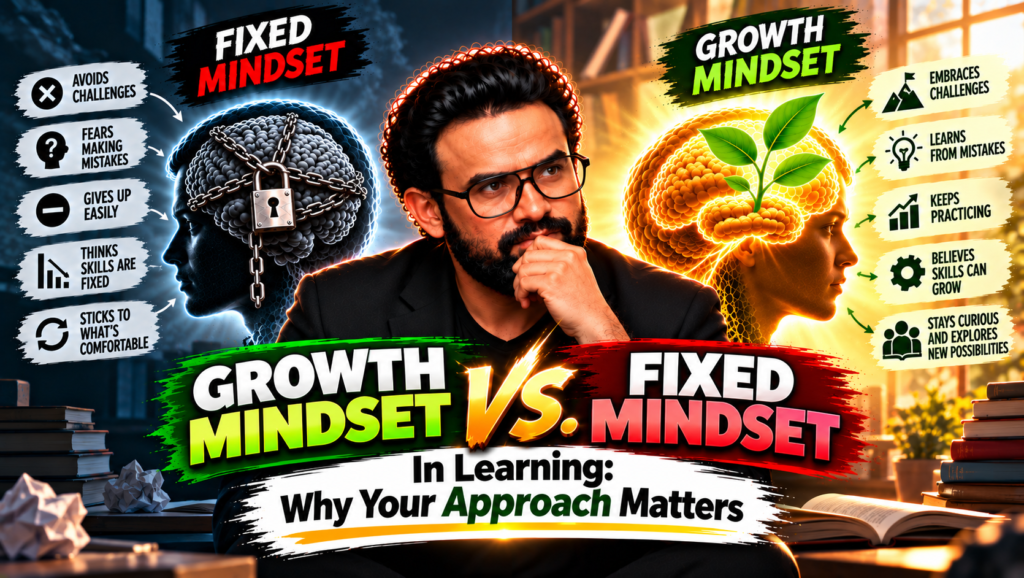
The First Reflects a Fixed Mindset-The Belief That Your Abilities Are Mostly Fixed. The Second Reflects a Growth Mindset-The Belief That Abilities Can Develop Through Learning, Practice, Feedback and Persistence.
Your Mindset Doesn’t Magically Make Learning Easy. But It Can Influence How You Respond When Learning Becomes Difficult.
And That Response Can Make a Big Difference.
What Is a Fixed Mindset in Learning?
A Fixed Mindset Assumes That Intelligence, Talent or Ability Is Something You Either Have or Don’t Have.
A Student with a Fixed Mindset Might Think:
- “I’m Bad at Math’s.”
- “I Can Never Learn Languages.”
- “I’m Not Creative.”
- “Everyone Else Understands This Faster Than Me.”
- “If I Make Mistakes, People Will Think I’m Not Smart.”
The Problem Isn’t Simply Having Difficulty.
The Problem Is Turning a Temporary Difficulty into A Permanent Identity.
Instead Of Thinking, “This Is Difficult,” The Mind Starts Saying, “I Can’t Do This.”
That Can Make a Person Avoid Challenges, Give Up Quickly, Or Choose Tasks That Feel Safe Rather Than Useful.
What Is a Growth Mindset in Learning?
A Growth Mindset Approaches Ability Differently.
Instead of Seeing Skills as Permanently Fixed, You See Them as Things That Can Develop.
You Might Think:
- “I Don’t Understand This Yet.”
- “I Need More Practice.”
- “What Can I Learn from This Mistake?”
- “Maybe I Need a Different Approach.”
- “Someone Who Knows This Can Teach Me.”
Notice Something Important: A Growth Mindset Doesn’t Mean Pretending Everything Is Easy.
It Means Believing That Difficulty Is Not Proof That You are Incapable.
Learning Takes Time. Progress Can Be Slow. Some Subjects May Require More Effort Than Others.
A Growth Mindset Simply Leaves the Door Open for Improvement.
The Same Problem, Two Different Approaches
Imagine Two Students Receive a Low Score on An Exam.
Student A: Fixed Mindset
“I Knew It. I’m Terrible at This Subject.”
The Student May Feel Embarrassed and Decide to Avoid Studying Because Another Attempt Could Lead to Another Disappointment.
Student B: Growth Mindset
“My Score Wasn’t Good. I Need to Figure Out Where I Went Wrong.”
The Student Reviews Mistakes, Asks Questions, Changes the Study Method and Tries Again.
The Difference Isn’t That Student B Enjoys Failure.
The Difference Is What Each Student Does Next.
One Sees the Result as a Judgment of Ability.
The Other Sees It as Information.
Why Your Approach Matters
Learning Isn’t Just About Collecting Information. It’s Also About How You Respond to Confusion, Mistakes, Feedback and Slow Progress.
Your Approach Can Influence Several Important Learning Behaviors.
1. You Become More Comfortable with Challenges
A Fixed Mindset May Encourage You to Avoid Difficult Tasks Because They Can Expose What You Don’t Know.
A Growth Mindset Makes It Easier to Say:
“This Is Challenging. Let’s See What I Can Learn.”
You Don’t Have to Love Challenges. You Simply Become More Willing to Face Them.
2. Mistakes Become Useful
Nobody Learns without Making Mistakes.
You Pronounce a Word Incorrectly.
You Solve a Problem Incorrectly.
You Forget Something You Studied Yesterday.
A Fixed Mindset May Interpret the Mistake As:
“I’m Not Good at This.”
A Growth Mindset Asks:
“What Does This Mistake Teach Me?”
That Small Change Can Turn Mistakes into Feedback.
3. You Become More Open to Feedback
Feedback Can Feel Uncomfortable When You Believe Your Performance Represents Your Intelligence or Worth.
But When Learning Is Viewed as a Process, Feedback Becomes Useful Information.
Instead Of Hearing:
“You Made Five Mistakes.”
You Can Think:
“Now I Know What I Need to Improve.”
Feedback Doesn’t Define You. It Helps Guide Your Next Step.
4. You Stop Comparing Your Beginning with Someone Else’s Experience
Have You Ever Watched Someone Do Something Effortlessly and Thought:
“I’ll Never Be Able to Do That.”
You are Often Comparing Your Beginning with Someone Else’s Progress.
That Person May Have Spent Months or Years Practicing.
Instead Of Asking, “Why Am I Not as Good as Them?”, Ask:
“What Can I Learn from How They Got There?”
Comparison Can Discourage You. Curiosity Can Teach You.
“I Can’t” Vs. “I Can’t Yet”
One of the Simplest Mindset Shifts Is Adding One Small Word:
Yet.
“I Can’t Solve This” Becomes:
“I Can’t Solve This Yet.”
“I Don’t Understand It” Becomes:
“I Don’t Understand It Yet.”
“I Can’t Speak Confidently” Becomes:
“I Can’t Speak Confidently Yet.”
The Word “Yet” Doesn’t Promise Instant Success.
It Simply Reminds You That Your Current Ability Is Not Necessarily Your Final Ability.
How To Build a Growth Mindset While Learning
You Don’t Need to Completely Change Your Personality to Develop a Growth-Oriented Approach.
Start With Small Habits.
Ask Better Questions
Instead Of:
“Why Am I Bad at This?”
Ask:
“What Part Am I Struggling With?”
Instead Of:
“Can I Do This?”
Ask:
“What Would Help Me Get Better?”
Better Questions Can Lead to Better Actions.
Focus On Progress
Don’t Measure Yourself Only by Final Results.
Look For Smaller Improvements:
- Did You Understand One More Concept?
- Did You Practice Longer?
- Did You Make Fewer Mistakes?
- Did You Try a New Method?
- Did You Ask for Help?
Small Progress Is Still Progress.
Reward the Process
Don’t Celebrate Only the Highest Marks, Perfect Performance or Final Achievement.
Also Recognize:
Effort, Consistency, Curiosity, Practice and Improvement.
These are the Behaviors That Support Long-Term Learning.
A Simple Learning Mindset Check
The Next Time You Struggle with Something, Pause and Complete These Three Sentences:
1. What Am I Struggling With?
Be Specific.
2. What Can I Do Differently?
Think About Practice, Guidance, Resources, Or A New Strategy.
3. What Is One Small Step I Can Take Today?
Then Take It.
This Turns Frustration into Action.
Growth Mindset Doesn’t Mean “Never Give Up”
A Growth Mindset Is Sometimes Misunderstood as Simply Working Harder No Matter What.
That’s Not the Point.
Sometimes Your Strategy Needs to Change.
Sometimes You Need Help.
Sometimes You Need a Break.
Sometimes You Discover That a Particular Goal Isn’t Right for You.
Growth Means Being Willing to Learn, Adapt and Make Better Decisions, Not Blindly Continue Doing the Same Thing.
Build Your Mega Mindset
Learning Becomes More Powerful When You Stop Asking:
“Am I Naturally Good at This?”
And Start Asking:
“How Can I Get Better at This?”
That Shift Creates Room for Curiosity.
It Creates Room for Practice.
It Creates Room for Mistakes.
And Most Importantly, It Creates Room for Possibilities.
Your Current Skill Level Is a Snapshot-Not Necessarily Your Final Destination.
So, The Next Time You Struggle with Something, Don’t Immediately Label Yourself.
Pause.
Learn.
Adjust.
Try Again.
Because A Mega Mindset Doesn’t Ask You to Believe You Can Do Everything.
It Encourages You to Believe That There Is More You Can Learn, Explore, And Improve.
And When Your Approach to Learning Expands, Your Possibilities Can Expand with It.
Mega Mindset. Mega Possibilities.
Frequently Asked Questions
1. What Is the Difference Between Growth Mindset and Fixed Mindset in Learning?
A Fixed Mindset Tends to View Abilities as Relatively Permanent, While A Growth Mindset Views Abilities as Developable Through Learning, Practice, Feedback and Effective Strategies.
2. Does A Growth Mindset Mean Believing I Can Learn Anything?
Not Necessarily. A Growth Mindset Is Not About Believing That Every Goal Is Guaranteed. It Is About Remaining Open to Learning, Improvement, Adaptation and New Strategies.
3. How Does a Fixed Mindset Affect Students?
A Fixed Mindset May Make Students More Likely to Avoid Challenges, Become Discouraged by Mistakes, Or Interpret Poor Results as Evidence That They Lack Ability.
4. How Can I Develop a Growth Mindset?
Start By Noticing Fixed Thoughts, using “Yet” Learning from Mistakes, Asking for Feedback, Focusing on Progress and Looking for Better Strategies When Something Isn’t Working.
5. Is Making Mistakes Important for Learning?
Mistakes Can Provide Useful Information About What Needs to Be Understood or Practiced. What Matters Is How You Respond to Them.
6. What Should I Say Instead Of “I’m Bad At This”?
Try Saying, “I’m Still Learning This,” Or “I Haven’t Figured This Out Yet.” This Keeps Your Attention On The Learning Process Rather Than Defining Yourself By Your Current Difficulty.
7. Can Adults Develop a Growth Mindset?
Yes. Adults Can Change How They Approach Learning by Becoming More Open to Feedback, Practicing New Skills, Trying Different Strategies and Treating Challenges as Opportunities to Learn.